Choosing the right body armour is one of the most important procurement decisions a security team will ever make. Get it wrong, and you risk under-protecting the people who rely on it every single day. Get it right, and you give your frontline staff the confidence and protection they need to do their jobs safely.
But with dozens of manufacturers on the market, all making bold claims about protection levels, user comfort, and operational durability, how do you compare body armour with genuine, certified quality from clever marketing?
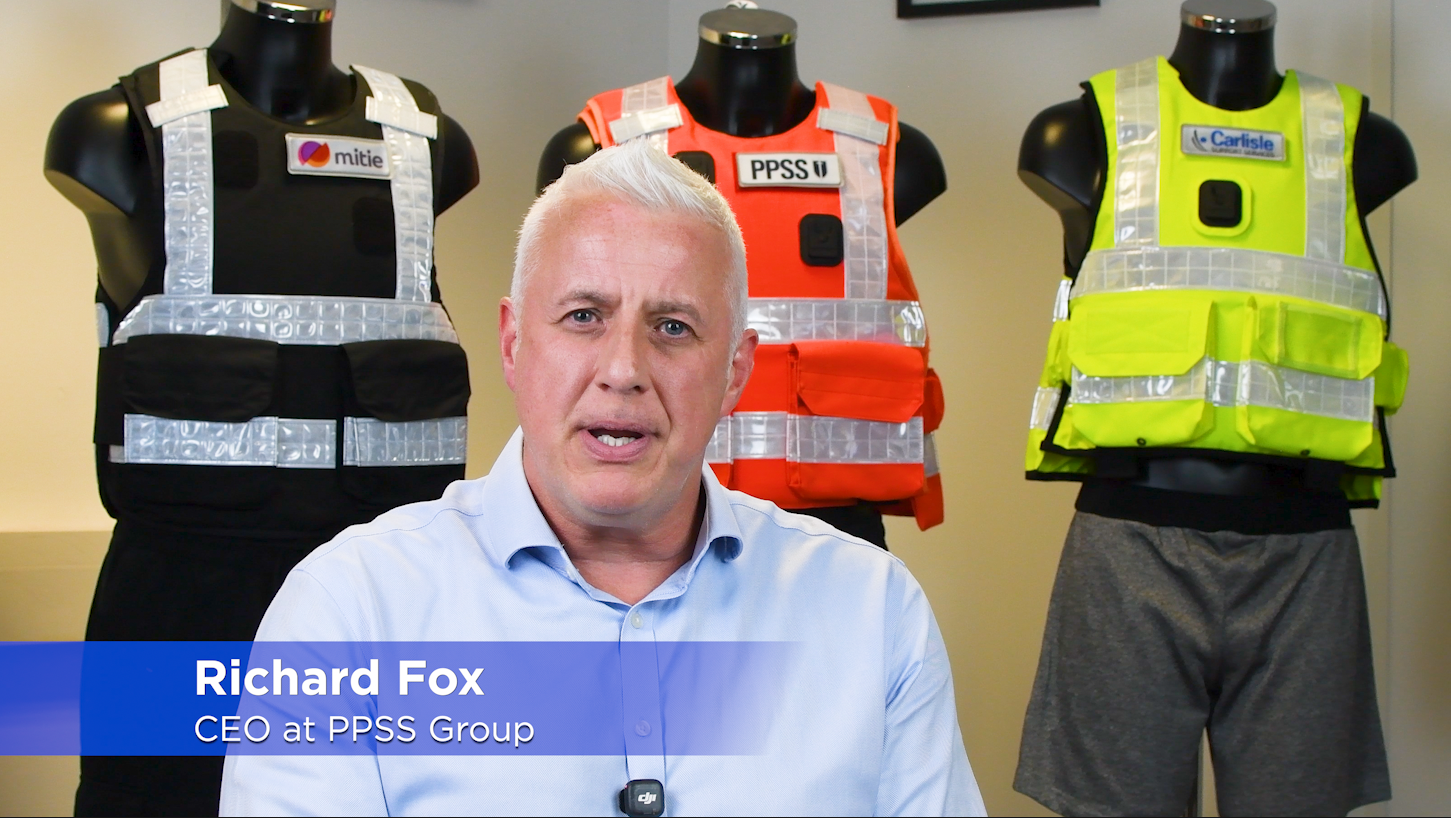
We sat down with Richard Fox, CEO of PPSS Group, to break down exactly what you should consider when buying body armour before you commit to a supplier. Here’s everything you need to know.
1. Start With Certification and Threat Levels
Before you do anything, you should consider the risks your team are facing daily. What type of environment does your team operate in, and what kind of threats will they realistically encounter during their shift? Then you need to match the threat level to the protection your team needs.
Once you’ve determined the threat level, the first thing any buyer should compare is certification level. Body armour is generally tested against three core threats:
- Knife attacks (edged weapon protection)
- Spike attacks (this is not the same as knife protection; a garment can pass one and fail the other)
- Blunt force trauma (impact from kicks, punches, or strikes)
For example, your team provide retail security for a UK shopping centre in the inner city. The security on site has historically faced threats from anti-social behaviour, shoplifting, and gangs. Typically, the only weapons that have been confiscated by security are knives, spikes/needles, bats or blunt force weapons. There have never been any cases of guns or firearms recorded at all.
In this scenario, your team would need body armour that has Home Office certification for Knifes (KR1), Spikes (SP1) and blunt force trauma. A genuinely reliable piece of body armour should be able to demonstrate protection against all three, tested to recognised Home Office standards such as KR1 and SP1.
NOTE: In this example, you do NOT need ballistic protection or certification. In the UK, gun-related crime remains among the lowest in the world, with police in England and Wales recording 5,103 non-air firearm offences in the year ending March 2025, which is a 21% decrease compared to the previous year. Remember, it’s not about sourcing the best body armour; it’s about choosing the right protection that matches the real-world threats your team face on a daily basis.
Here’s the catch: not every manufacturer that claims Home Office certification holds it. This is a surprisingly common issue in the industry, and it means buyers can’t simply take a spec sheet at face value.
How to verify certification claims
If you’re unsure whether a body armour manufacturer holds Home Office certification, there is a quick and easy way to find out. The free, publicly available Home Office Police Equipment Database lets you verify certified products and suppliers online.
Simply search “Police Equipment Database” on Google, and you’ll find an official Home Office-branded website that lists every manufacturer in the UK holding genuine Home Office certification.
The database lets you search by:
- Body armour type
- Manufacturer name
- Threat/protection level
This is genuinely one of the most useful due-diligence tools available to procurement teams, and it takes the guesswork out of verifying a supplier’s claims.
2. Prioritise Blunt Force Protection
It’s easy to assume that knife protection is the top priority when comparing body armour; after all, it’s the threat most associated with stab vests. However, according to extensive research conducted by PPSS Group, blunt force trauma, i.e. being kicked or punched, is in fact the number one threat security officers face daily, not bladed weapons.
That doesn’t mean knife protection isn’t important; it absolutely is. But if you’re comparing two otherwise similar products and one lacks robust blunt force trauma certification, that’s a meaningful gap. When you’re evaluating manufacturers, make sure you’re specifically asking about their blunt trauma testing and certification, not just their knife and spike ratings.
Another thing to consider is that different types of body armour specialise in protection from various threats. For example, soft armour such as Kevlar® is a polymer material (aramid fibre) made primarily to protect from gunfire and ballistic threats. It is extremely heavy, and while it can protect from bullets, it is NOT designed to protect against needles or blunt force trauma.
NOTE: A hypodermic needle will go straight through a Kevlar® vest, and it will start to degrade when exposed to sunlight (UV light) and moisture.
On the other hand, hard body armour such as carbon fibre is a lightweight, rigid material designed to protect against knives, spikes, needles, and blunt force.
Carbon fibre is an extremely strong material made from thin crystalline filaments of carbon atoms. It is around five times stronger than steel, while its high durability and lightweight properties make it an ideal material to wear day in and day out.
3. Considering the Weight
Nobody wants to spend an eight-hour shift wrapped in a heavy, cumbersome vest. Weight is a real comfort and performance factor, and it’s one that’s easy to compare objectively once you know what to look for.
Manufacturers typically express weight as an areal density, measured in kilograms per square metre (kg/m²).
For context, a well-optimised panel might weigh around 6.33kg/m², meaning a one-metre-square panel would weigh 6.33kg. If a competing product comes in at 8 or 9kg/m², that tells you instantly if it will feel considerably heavier to wear over a long shift.
Where can you check this?
- The manufacturer’s own website (though always cross-check)
- The Police Equipment Database, which lists areal density alongside certification data
Comparing weight across a shortlist of suppliers using consistent, verifiable figures, rather than marketing language like “lightweight” or “ultra-comfortable”, gives you a much fairer basis for comparison.
4. Understand Service Life and Environmental Durability
Body armour doesn’t last forever, and service life varies significantly by product and manufacturer. As a general guide:
- Higher-quality armour can last up to ten years
- Some softer armour types may only last around five years
- Exposure to heat, sweat, sunlight and moisture can accelerate deterioration significantly, especially in softer materials
When comparing suppliers, ask directly about expected service life under realistic operational conditions, not just in laboratory storage, and how environmental exposure affects the garment’s protective performance over time. A cheaper vest that needs replacing in half the time isn’t necessarily the better investment.
5. Look Beyond the Product and Evaluate the Provider
Evaluating the body armour material, weight, certification, and product specifications is critically important. However, one factor frequently overlooked is the product provider. Trusting the manufacturer matters as much as the product they’re selling.
When comparing body armour suppliers, you should consider:
Operational experience – Does the team behind the product have genuine operational or frontline experience? Do they understand the specific threats your staff face, or are they simply selling a product?
Track record – Is their body armour currently deployed operationally with other organisations? How long-standing are their customer relationships?
Lived experience on staff – Suppliers with team members who’ve worked in security, policing or related frontline roles tend to have a deeper, more practical understanding of what buyers need.
A supplier that understands the operational reality of your team, rather than one that only manufactures and sells, is far more likely to deliver a product genuinely fit for purpose.
6. Confirm Compliance with PPE Regulations
Body armour isn’t just a product; it’s legally classified as Category III Personal Protective Equipment (PPE) because it protects against serious and potentially life-threatening risks. This means legally, any manufacturer providing body armour must comply with PPE Regulations.
This classification comes with strict regulatory requirements. Legitimate manufacturers must:
- Undergo audits from an accredited notified body
- Pass those audits successfully
- Hold both a Module B (EU-type examination) and Module D (quality assurance of the production process) certificate
These certificates provide the paper trail that proves a manufacturer genuinely complies with PPE regulations, and any reputable supplier should be able to provide them without hesitation. If a manufacturer is reluctant or unable to provide this documentation, treat that as a significant red flag.
Putting It All Together: A Simple Comparison Checklist
When you’re comparing body armour options side by side, run through this checklist for each supplier:
- Certification: Verified on the P.E.D website, not just claimed by the seller
- Threat coverage: Knife (KR1), spike (SP1), and blunt force trauma (VPAM)
- Blunt force protection: Given this is the No. 1 threat for security in the UK
- Weight (areal density): Compared in kg/m² using consistent figures
- Length of Service life: Realistic expectations under operational conditions
- Environmental durability: Resistance to heat, sweat, sunlight and moisture
- Operational credibility: Frontline experience within the manufacturer’s team
- Track record: They have credible, long-standing, active customer relationships
- PPE compliance: Valid Module B and Module D certificates on request
Why This Matters
Body armour procurement isn’t just a box-ticking exercise; it’s a decision that directly affects the safety of the people wearing it, often in high-risk, high-pressure situations. Marketing claims are easy to make; genuine certification, operational understanding and regulatory compliance are much harder to fake, and much easier to verify, once you know where to look.
Before committing to any supplier, check their credentials against the Home Office Police Equipment Database, ask direct questions about blunt force trauma protection and service life, and dig into their operational track record. A few extra hours of due diligence at the procurement stage can make a lasting difference to the safety and confidence of your team.
Want to learn more about navigating PPE procurement? Explore our related guides on PPE regulations and compliance and what you should consider when buying body armour for your team.
About the Author
Richard Fox is the CEO of PPSS Group. With over 30 years of service in the British Armed Forces and continued service as an Army Reservist Company Sergeant Major, he brings extensive operational leadership experience alongside deep knowledge of PPE compliance, quality assurance, and international safety standards. Appointed CEO in 2025 after serving as Global Operations Director, Richard oversees strategy and day-to-day operations while ensuring PPSS Group maintains the highest levels of product performance and certification.