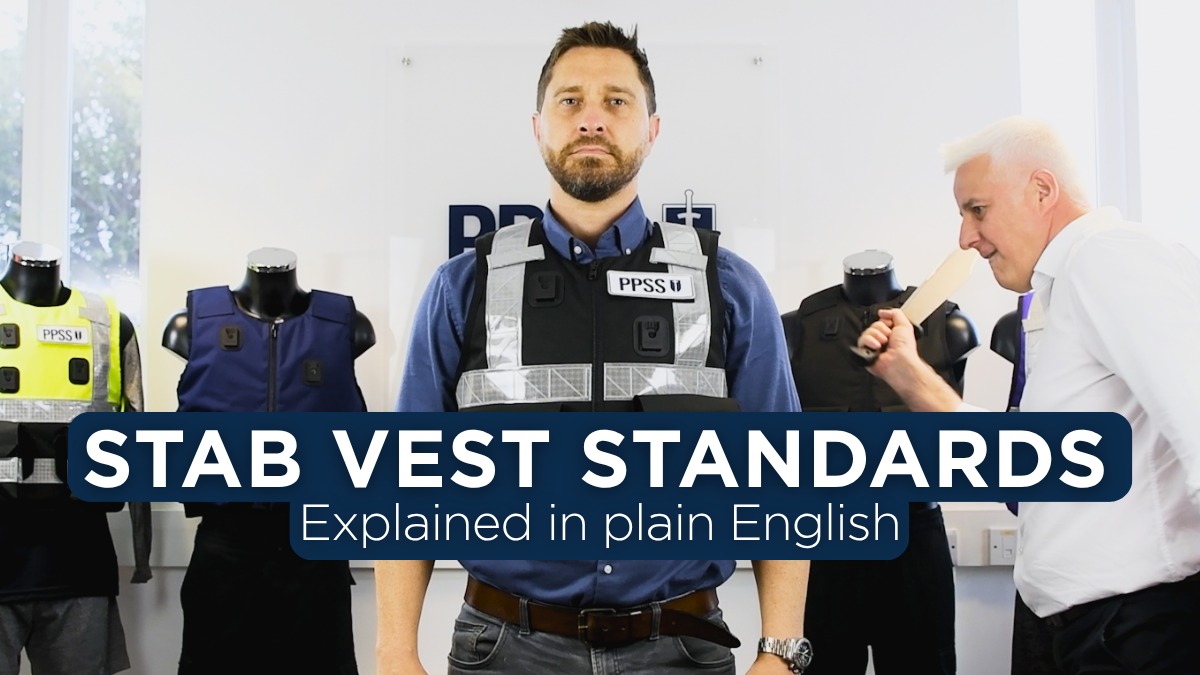
Body armour standards can be confusing. The thought of reading one from cover to cover is about as tantalising as reading your car’s manual. We all know there is important information in there, but very few of us volunteer to read every page.
So I thought I would write a short article that removes as much technical jargon as possible, explains the main stab-resistant body armour standards in plain English, and how to compare body armour, plus a few observations from my own experience along the way.
This article focuses on stab-resistant body armour. Ballistic protection is a separate subject, with its own threats, standards and test methods.
1. What are Stab Vest Standards – and Why Does Certification Matter?
At its simplest, a recognised body armour standard gives us a controlled, repeatable way to establish whether a product actually provides the protection it claims.
That matters because words alone can be fairly meaningless. “Stab proof” is a term I still hear surprisingly often, but I would be extremely cautious about describing any body armour as genuinely stab proof. Give somebody an extreme enough weapon, enough force and enough determination and virtually every protective system has a limit.
“Stab resistant” is the correct terminology, but even that tells us little without a recognised standard behind it. A denim jacket would offer some resistance if I dropped a kitchen knife onto it from a foot above. That certainly would not make it a stab vest.
That is really the purpose of standards. They replace vague claims with a defined weapon, controlled test conditions, and measurable performance requirements. A manufacturer submits the armour to an approved test facility and demonstrates that it meets the standard requirements.
The Home Office system also goes further than simply passing the original body armour certification test and then putting the certificate in a drawer. Production Quality Testing, or PQT, takes armour from production and tests whether what is being manufactured remains consistent with the product originally certified. In-Life Monitoring, or ILM, tests armour that is currently operational to make sure it is still performing as intended.
For us at PPSS Group, that means certified body armour is not tested once and forgotten. It remains subject to continued assessment through its certification life.
Another important part of certification is product life expectancy. Body armour has a working life and should never be treated as something to be issued and forgotten about indefinitely. I sometimes describe it simply as the armour having a “sell-by date”. It doesn’t suddenly stop working the next morning, but once the declared product life expectancy has passed, you should not assume the same level of protection without further evidence.
I once bought a set of body armour plates for an overseas contract and later stored them at home. A couple of years later, while sorting through some kit, I took them out and found the material was literally flaking off as I inspected them. Body armour can deteriorate over time, even when it’s not being worn.
It is also worth being careful with wording such as “tested to KR1”. That can sound reassuring, but it is not the same as saying a product holds current Home Office KR1 certification. If it is genuinely Home Office certified, the manufacturer should be able to show the certification and the product should be listed on the Police Protective Equipment Database.
If you rely on PPE to protect you from a potentially fatal attack, you as the buyer should have confidence not only in the panel that originally passed the test, but in the armour coming off the production line later and the armour already being worn in the field.
2. The Main Stab Vest Standards
Around the world, different government bodies have varying body armour standards. Three of the most recognised in the markets we work in are the UK Home Office Body Armour Standard, the US National Institute of Justice standard, and the VPAM system. They are not identical, and there are no simple conversions where one automatically equals another.

UK Home Office Body Armour Standard
The current UK system is the Home Office Body Armour Standard 2017, Publication 012/17. For stab-resistant armour, the levels most people will come across are KR, meaning Knife Resistance or SP, meaning Spike Resistance. So KR1 is Knife Resistance Level 1, while SP1 is Spike Resistance Level 1.
The standard covers controlled testing against knife and spike threats and includes formed armour testing, Production Quality Testing and In-Life Monitoring. It is designed to give confidence not only that an armour can pass an initial test, but that the certified construction continues to perform properly over time.

US NIJ Standard
In the US, the principal stab-resistant body armour standard is NIJ Standard 0115.00.
There is an interesting relationship between the British and American systems. The US stab standard drew heavily on earlier UK stab testing standards, while the US NIJ ballistic standards have helped shape the UK’s approach to ballistic testing.
NIJ 0115.00 sets minimum performance requirements and test methods for stab-resistant personal body armour against edged and pointed weapons. For a buyer, the important thing isn’t remembering another number; it is understanding exactly what threat that number represents.

VPAM Stab and Impact Resistance Standard
The third standard worth mentioning is VPAM KDIW 2004.
We pursued VPAM testing at PPSS Group partly because of its approach to blunt force impact. VPAM takes this area extremely seriously, with its W impact classifications increasing from W1 to W5, where the armour is subjected to a 100 joule impact and the resulting deformation behind the armour is measured.
This has always been important to us because stopping something from penetrating the armour is only part of the story. The energy behind an attack does not simply disappear.
3. What Threats Can a Stab Vest Actually Be Tested Against?
An important factor for buyers to consider is the threat level body armour can be tested against. I’ve often heard the term “stab vest” used to describe one universal level of protection. It does not. Having briefly covered KR and SP, let’s take a closer look at what those tests involve and what the results actually tell us.
Knife Resistance – KR1
Knife resistance testing uses a specific, standardised blade so armour tested at one approved test facility uses the same defined threat as armour tested elsewhere. The weapon, impact energy, strike positions and other conditions are controlled so results can be compared accurately.
One thing that often surprises people is that Home Office knife certification does not necessarily mean zero penetration. Limited penetration is allowed within defined parts of the test, and personally I think this deserves more attention than it gets.
The Home Office standard sets allowable penetration depths because its purpose is ultimately to protect the wearer from life-threatening injury. However, that does not mean I am comfortable treating permitted penetration as something buyers should ignore. My view is straightforward: if modern armour can achieve better performance, why wouldn’t we want it?
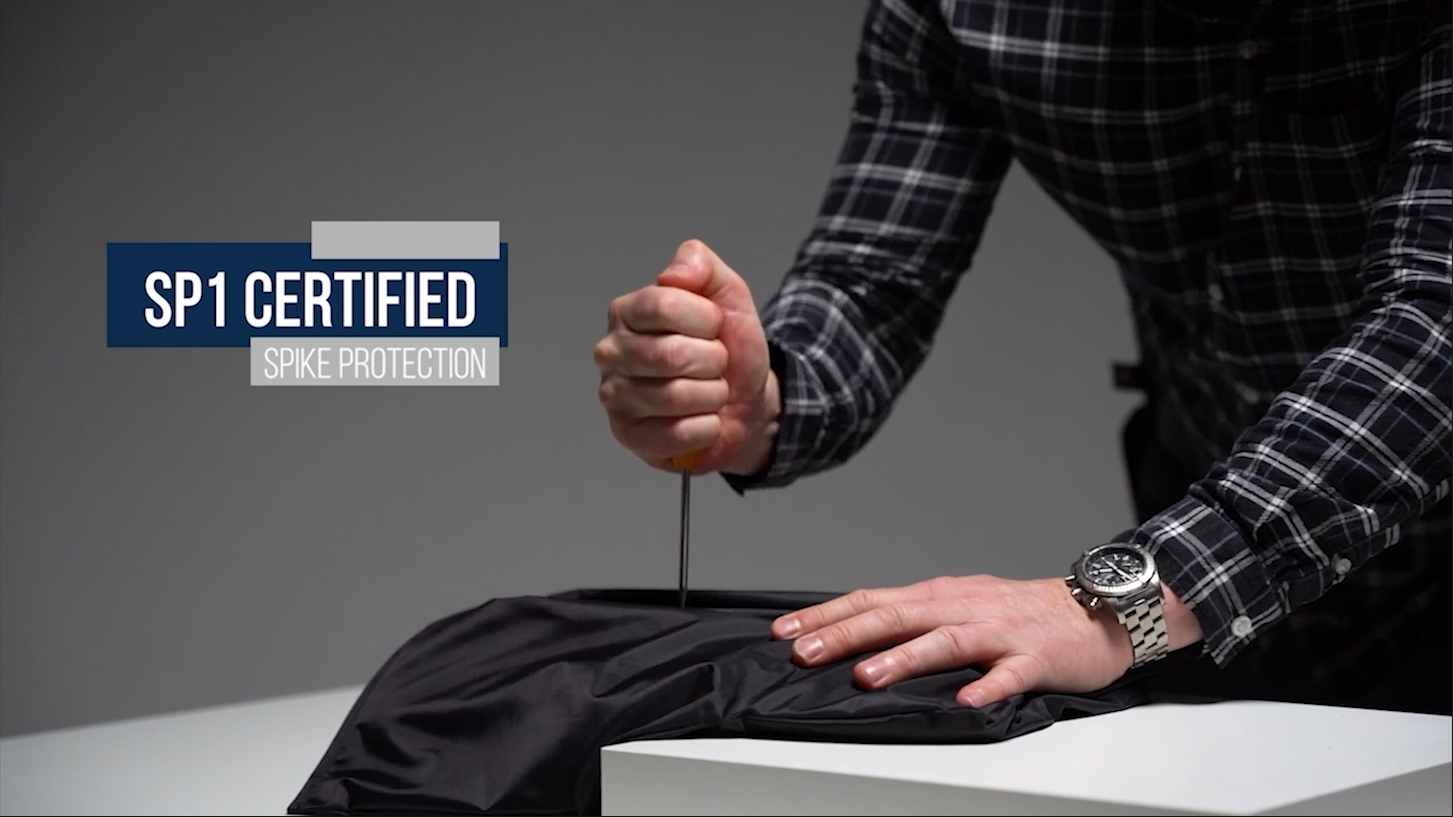
Spike Resistance – SP1
Spike protection is the area I think buyers should pay considerably more attention to. A knife presents a comparatively broad blade and cutting edge, whereas a spike concentrates the impact through an extremely small point. Once that point penetrates a protective construction, the narrow shaft behind it can travel through the material very differently from a conventional knife blade.
I have demonstrated this many times during presentations using different protective materials. Something that can be remarkably difficult to penetrate with a knife can sometimes be penetrated surprisingly easily by something as fine as a hypodermic needle. Just to be absolutely clear, a hypodermic needle is not the Home Office SP1 test weapon, so I am not suggesting that sticking a needle through something constitutes an SP1 test. It simply demonstrates the principle very effectively: knife resistance does not automatically mean resistance to every pointed threat.
This is where I struggle with KR1 body armour. A KR1 vest has legitimately passed a recognised test for knife resistance, and I am not questioning that, but my question is: why would you stop there?
Sharpened screwdrivers, improvised spikes and pointed weapons are entirely realistic threats in security, custodial, healthcare and frontline environments. If someone is already at sufficient risk to justify wearing stab-resistant body armour, why would they choose a vest without spike protection? The threats facing security officers today are severe, and I personally believe spike protection deserves serious consideration when purchasing body armour.
Blunt Force Impact
Blunt force is another area that often gets overlooked because body armour conversations naturally focus on knives and spikes. Yet everyday violence can involve punching, kicking, striking and hitting, as well as objects such as poles, bars, bats and other improvised weapons.
The consequences can include severe bruising, broken ribs, fractures and internal injury. A protective panel that stops an object from penetrating it does not automatically mean the person behind that panel walks away unharmed. Even with a knife or spike attack, the kinetic energy behind the strike still has to be absorbed somewhere.
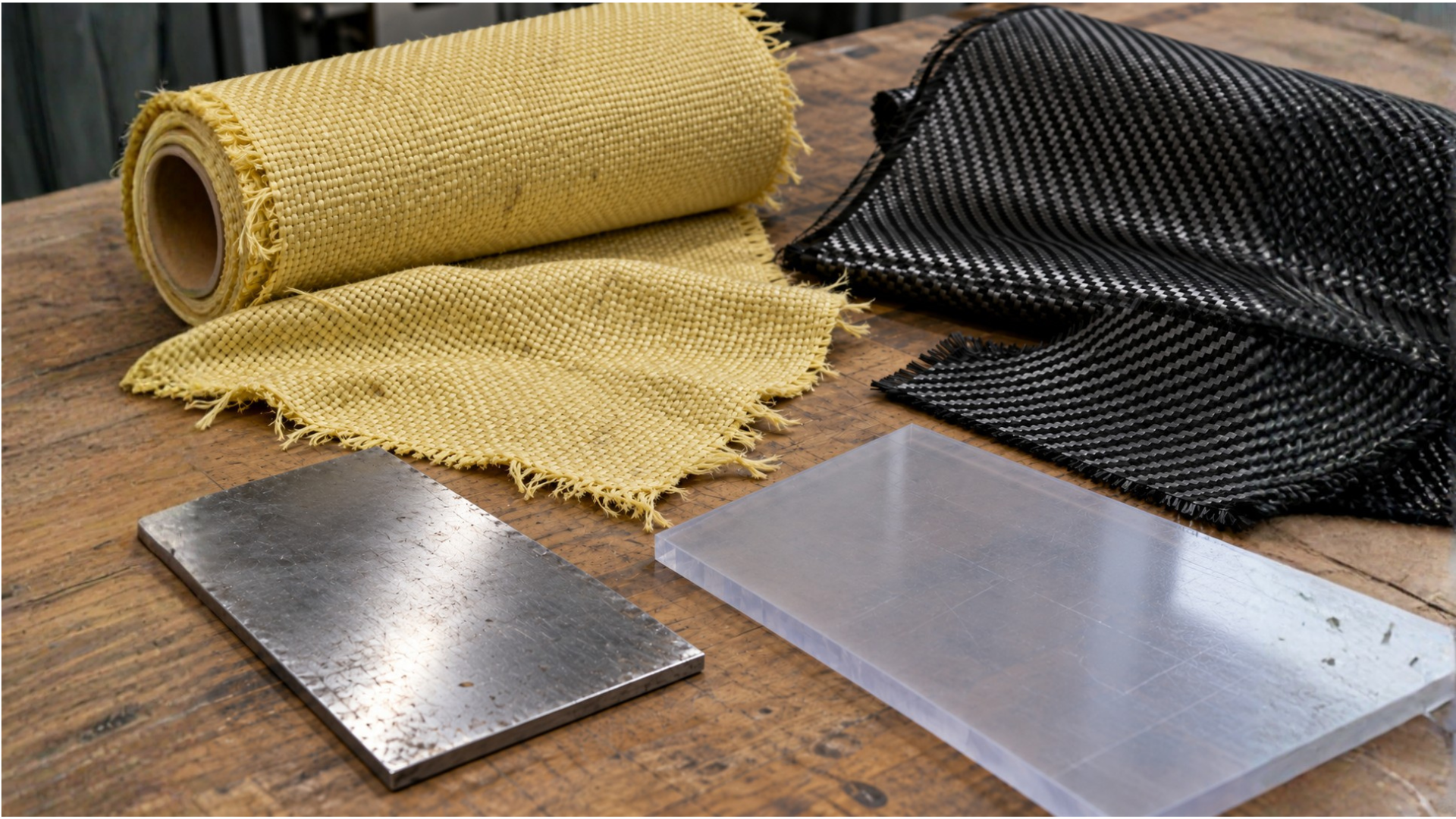
You do not need to be a carbon fibre engineer to understand why measuring deformation behind the armour matters. The question is straightforward: the armour stopped the threat, but what happened to the person behind it? For me, both parts matter.
4. Where and How Is Stab-Resistant Body Armour Tested?
Proper certification testing is considerably more scientific than somebody standing in a workshop repeatedly stabbing a vest and announcing that it looks good. Even now, I still picture everybody at the test house walking around in white lab coats like something out of Jurassic Park.
White coats aside, the process is carefully controlled. Testing uses defined knives or spikes fitted to specialist equipment so that impacts can be delivered at known energy levels. The armour is placed against prescribed backing material, and strikes are delivered at specific positions and angles before the laboratory records the results, particularly the depth of any penetration.
The Home Office process also considers formed armour rather than only testing panels perfectly flat. That matters because people are not flat. Body armour has to fit around the wearer’s torso and may perform differently when tested in a shaped configuration.
The same point applies to armour described as unisex. Under the Home Office standard, that is not simply a case of a manufacturer deciding one shape should fit everybody and putting ‘unisex’ on the label. Formed armour submitted for certification has to be assessed using defined female torso forms, representing different body shapes and sizes, and the technical file must identify how the armour is intended to be worn and certified.
That is important because female body shape can present very different challenges for fit, curvature and protective coverage. The 2017 standard introduced female test forms based on actual body measurements, giving a more representative assessment of formed armour. So when a Home Office certified product is genuinely listed as unisex, that classification reflects specific testing requirements it has met, rather than simply being a manufacturer’s claim.
This is also something I would encourage buyers to consider when looking at flexible armour, particularly designs that use separate sections or overlapping elements. Ask how protection is maintained when the wearer bends, twists or sits down and how any joints, gaps or overlaps have been tested. The important question is whether protection remains consistent across the panel as it moves.
5. Why Two Certified Stab Vests Can Still Be Very Different
Passing the same standard does not mean two body armours are the same product. Once you have established that the armour genuinely holds the certification being claimed, there are still some very practical questions worth asking.
One of the first things I would look at is weight. You can have armour offering good protection levels but varying hugely in overall mass, and that matters when somebody may be wearing it for a 10 or 12 hour shift. Something that feels acceptable when you pick it up for thirty seconds can become very different several hours later, so weight should always form part of the buying decision.
Thickness matters for similar reasons. A thicker vest may still provide excellent protection, but it can feel considerably bulkier once somebody is sitting in a vehicle, working behind a desk or moving around for hours. Thickness, weight and comfort often interact, so the armour needs to be considered as something somebody actually has to wear, not simply something that has passed a laboratory test.
Then there is service life, which I think is far more important than many buyers realise. The Home Office does not prescribe one universal lifespan for all armour; the manufacturer declares the product life expectancy and should be able to support that claim with evidence. In Life Monitoring is particularly valuable here because it helps assess armour that has actually been worn operationally during that period.
You would be surprised how quickly some incredibly strong materials can lose their integrity if they age badly or are stored in poor conditions. My own experience was a useful reminder that something can look impressive when new and still deteriorate over time.
That is why I think buyers should ask how long the armour is designed to last, what evidence supports that declared life, how it should be stored and maintained and how the end user will know when it has reached the end of its working life.
The practical questions therefore become quite simple: What exact protection level does it hold? Does that include spike as well as knife? What does it weigh? How thick is it? How long is its declared service life? And can I independently verify the certification being claimed?
Who Is Behind the Armour?
One final point worth considering is the company behind the product. A certification is essential, but body armour is not just a technical product; it is something being worn by real people in real operational environments, and I think there is value in dealing with people who understand that.
PPSS Group has benefited over the years from people with operational experience spanning military, policing, security, custodial and other frontline environments. That does not make us a room full of carbon fibre professors, and I would never pretend otherwise. We work with very good technical specialists where that expertise is required, but we also understand protective equipment from the wearer’s point of view.
That experience shapes how we work with customers. We are more than happy to meet, discuss the threats they are facing, look at risk assessments and help identify what level of protection is actually appropriate for the role. We are not simply here to put a vest in a box and send it out of the door.
Sometimes that means explaining why a certain standard matters. Sometimes it means helping customers balance the protection required with weight, comfort and the practical demands of the job. The aim should always be to understand the real risk first and then choose the protection around it.
Understand the threat. Understand the standard. Then choose the armour.
About the Author
Jim Still is the Director of Business Development at PPSS Group and a former Royal Marine Commando. After serving in Afghanistan and Iraq and working as a Private Military Contractor, he brings extensive experience in risk management and personal protection.
Since joining PPSS Group in 2016, Jim has focused on developing and expanding protective solutions that help frontline professionals operate more safely in high-risk environments.