
Retail security today looks very different from even a decade ago. Historically, loss prevention focused primarily on opportunistic shoplifting and occasional in-store disputes. While theft was always a concern, incidents were generally isolated and rarely escalated into serious violence. That landscape has changed significantly.
Recent data from the Office for National Statistics (ONS) and industry bodies shows that retail crime, particularly shoplifting and violence against workers, has increased sharply across the UK.
A Sharp Rise in Recorded Offences in Retail Crime
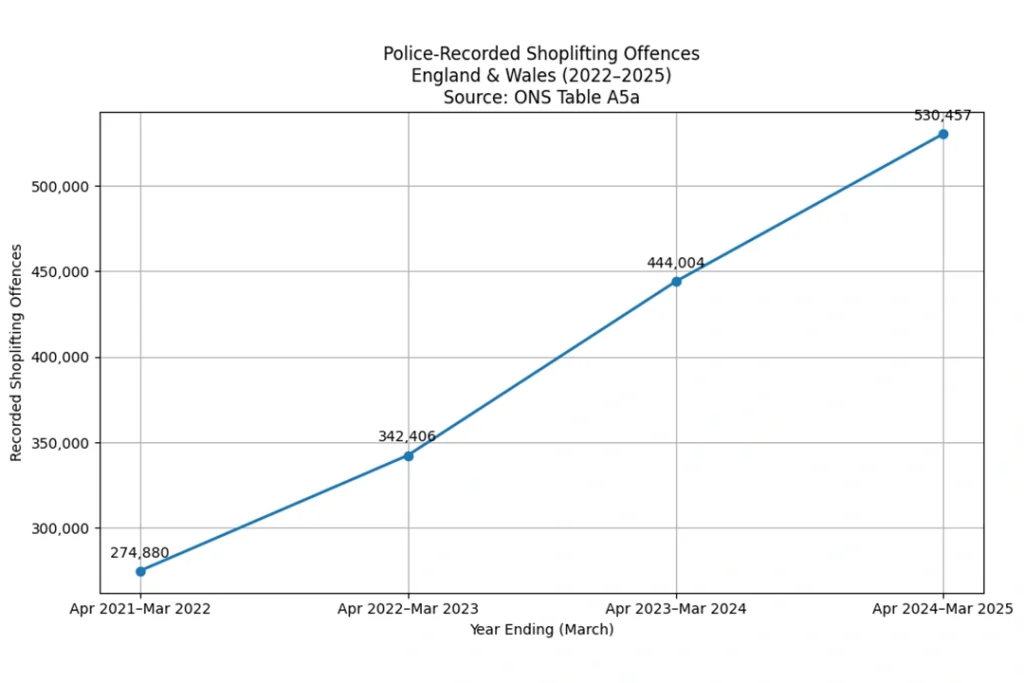
Official figures show a clear upward trend in retail-related crime:
- Shoplifting offences in England and Wales rose by approximately 20% in the year to March 2025, reaching over 530,000 recorded offences – the highest level since records began in 2003.
- Retailers reported more than 20 million shoplifting incidents in the year to 2024 – equating to roughly 55,000 thefts per day when including unreported cases.
- Total losses to UK retailers from customer theft, prevention measures, and associated costs reached £4.2 billion annually in 2023/24.
- Convenience stores alone recorded an estimated 6.2 million theft incidents in the most recent reporting year.
These figures reflect more than short-term fluctuation. They point to sustained pressure on the retail sector, with organised retail crime and repeat offending becoming more prevalent.
Violence and Abuse Against Retail Workers Is Also Increasing
Retail crime is no longer solely about stock loss. The human impact has intensified. According to the British Retail Consortium (BRC):
- Incidents of violence and abuse rose to over 2,000 per day, compared with approximately 1,300 per day in previous years.
- Retailers report around 70 weapon-related incidents per day.
- Industry surveys indicate that a majority of retail workers have experienced threats, abuse, or violence linked to theft or robbery.
This shift changes the nature of retail security entirely. What was once primarily loss prevention has, in many environments, become frontline risk management.
What This Means for Retail Security Teams
Three major changes now define modern retail security risk:
- The volume of theft has increased to the point where incidents are daily and often persistent. Retail crime is no longer sporadic — it is systemic.
- Incidents increasingly involve aggression, intimidation, and organised groups rather than opportunistic petty theft.
- Exposure of Staff
- Security officers and retail employees face higher levels of confrontation, threats, and weapon-related risk than in previous decades.
- The cumulative effect places sustained pressure on security teams, store management, and frontline staff.
How Retailers Are Responding
To address escalating risks, many retailers have invested in:
- Advanced CCTV and AI-driven analytics
- Personal Protection Measures
- Body-worn cameras
- Conflict management and de-escalation training
- Improved incident reporting systems
- Greater intelligence sharing with law enforcement
- In higher-risk environments, consideration of certified stab vests for frontline security personnel
However, many industry professionals argue that staffing levels, legal deterrence, and police response capacity have not kept pace with the scale and frequency of offences. This creates operational gaps particularly in high-footfall urban environments.
A New Era of Retail Security Risk
Retail security has evolved from visible deterrence to managing complex, high-frequency and, at times, violent threats. Technology plays a growing role. Training is increasingly critical. But the central factor remains people. Security professionals and retail workers are operating in an environment that is measurably more volatile than in previous years. Understanding these trends is not simply about acknowledging rising statistics, it is about recognising the real and personal risks faced by retail professionals every day.
About the Author
Jim Still is the Director of Business Development at PPSS Group and a former Royal Marine Commando. After serving in Afghanistan and Iraq and working as a Private Military Contractor, he brings extensive experience in risk management and personal protection.
Since joining PPSS Group in 2016, Jim has focused on developing and expanding protective solutions that help frontline professionals operate more safely in high-risk environments.